What Is Alert Fatigue and How to Reduce It
Learn what is alert fatigue, why too many low-value notifications hurt response times, and how to design alerts that protect real incidents
Alert fatigue is the declining ability to notice and act on real signals because notifications are repetitive, irrelevant, or missing context. It isn't a volume problem, even a quiet monitoring system can exhaust responders if its alerts are difficult to interpret or reach the wrong person.
You're investigating a deployment when another availability warning arrives. The message looks familiar, the service recovered last time, and nobody has explained what you should do differently. You dismiss it and return to your terminal, not because reliability doesn't matter, but because the notification hasn't earned your attention.
The Moment an Engineer Mutes the Channel
Consider a hypothetical on-call shift. An engineer is investigating a slow checkout endpoint while the monitoring channel fills with repeating probe failures and recovery messages. Each notification interrupts the same investigation, but none explains whether customers are still affected.
The engineer checks the dashboard, sees mostly healthy results, and mutes the channel. Later, a regional reachability failure appears among messages that look almost identical to the earlier noise. The engineer doesn't see it until a customer reports trouble.
The failure happened before the mute
It's tempting to treat the mute button as the mistake. That misses the operational problem: the engineer had already learned that checking this channel usually meant spending attention without gaining useful information.
In this example, the monitoring stack detected events, but the notification design didn't help the responder distinguish them. A transient probe failure and a persistent regional outage arrived with the same apparent importance.
Practical rule: When someone mutes an operational channel, investigate what the channel asks them to interpret, not just whether they followed the on-call policy.
A useful incident review would ask:
- Message clarity: Could the engineer distinguish a new failure from an update to an existing problem?
- Customer impact: Did the alert explain which endpoint or region was affected?
- Response ownership: Was the person receiving the message responsible for investigating it?
- Operational value: Did opening the notification change the engineer's next action?
The engineer's decision was understandable, though the resulting silence was unsafe. Treating that tension as a design problem gives the team something concrete to fix.
The aim isn't to persuade engineers to tolerate interruptions indefinitely. It's to make urgent messages recognizable, useful, and worth opening, so responders don't need to choose between concentrating on an incident and hearing about the next one.
What Alert Fatigue Actually Means
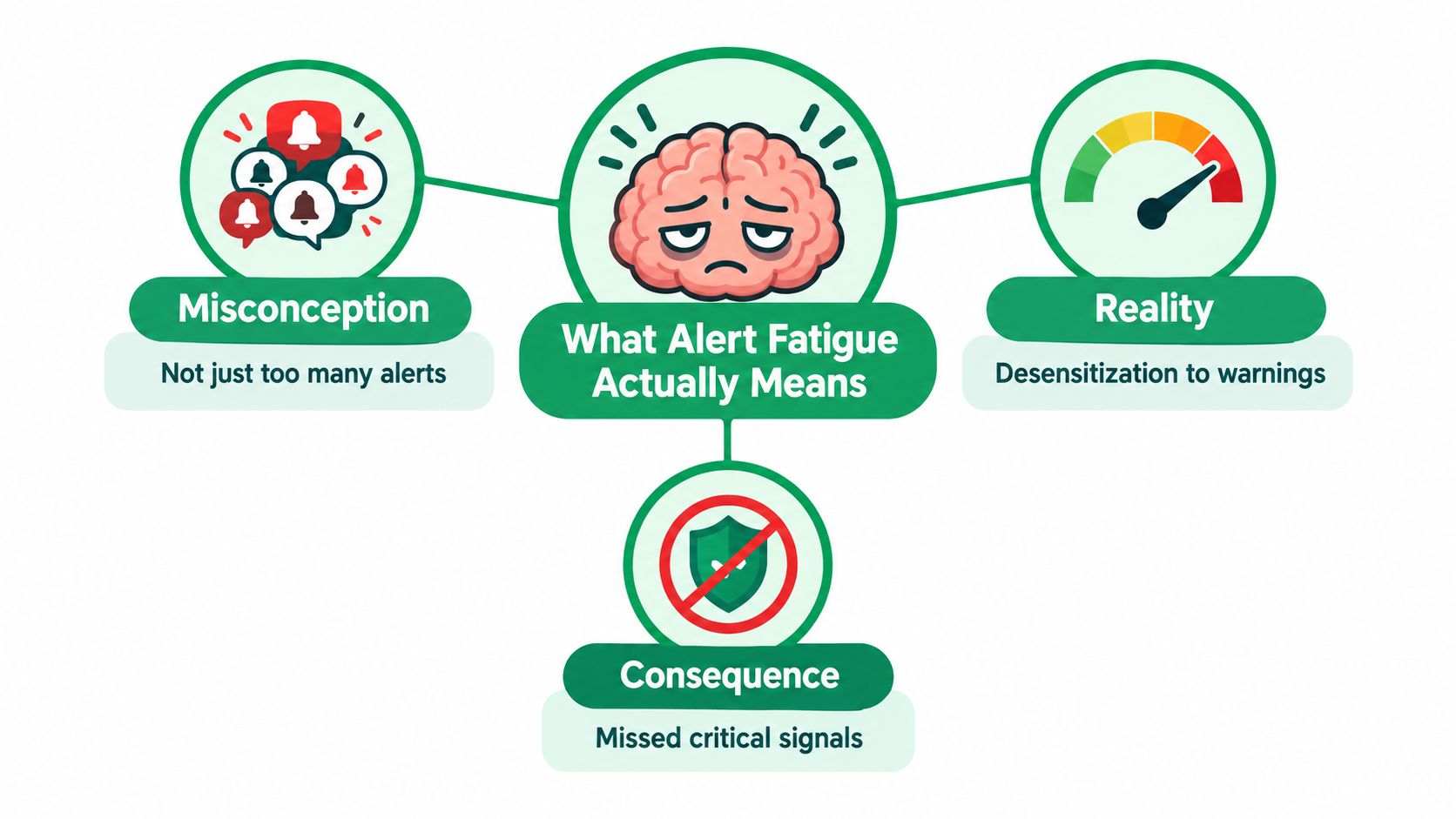
The question “What is alert fatigue?” needs an answer that describes behavior, not just a crowded inbox. A useful working definition is a deterioration in a responder's ability to detect, interpret, and appropriately act on warnings when surrounding messages demand attention without enough operational value.
These failures can happen at different stages. Someone might not notice a notification, skim it using a familiar mental shortcut, or struggle to understand its relevance. A systematic review of primary-care alert fatigue identifies frequency, presentation, accuracy, and contextual nuance as influences on whether people act.
The distinction between notification quantity and human response is central to the concept.
Volume and quality aren't interchangeable
Think of a car alarm that regularly sounds without an apparent emergency. Eventually, people nearby stop looking outside. The alarm still makes noise, but listeners no longer treat the sound as reliable evidence that they should act.
In monitoring, alert volume means how many notifications arrive. Alert quality means how effectively each notification supports a decision.
| Dimension | Useful question |
|---|---|
| Volume | Can the responder reasonably review the incoming workload? |
| Quality | Can the responder understand why this message matters? |
| Response | Does the responder take the appropriate action? |
A busy channel can remain useful if messages are distinct, well prioritized, and actionable. A quiet channel can still create fatigue if every notification requires detective work or repeatedly asks for action from someone who can't help.
For teams also considering the engineering side of scaling real-time monitoring infrastructure, keep human response capacity alongside collection and processing capacity. Handling events efficiently doesn't automatically make the resulting notifications understandable.
This isn't a diagnosis of an engineer's attitude. It's a way to evaluate whether the alerting workflow supports reliable decisions under real working conditions.
Where the Concept Came From and Why It Travels
Clinical monitoring gives alert fatigue a history with consequences far beyond an annoying notification sound. Hospitals relied on alarms to call attention to patient conditions, yet frequent false or low-value alarms made the important signals harder to recognize.
Between January 2005 and June 2010, the FDA's device-incident database recorded 566 patient deaths associated with monitoring-device alarms; separately, the Joint Commission recorded 98 alarm-related events between January 2009 and June 2012, including 80 resulting in patient deaths, as summarized in the National Library of Medicine's alarm-fatigue overview. These are distinct databases and observation periods, not figures to combine into a single total.
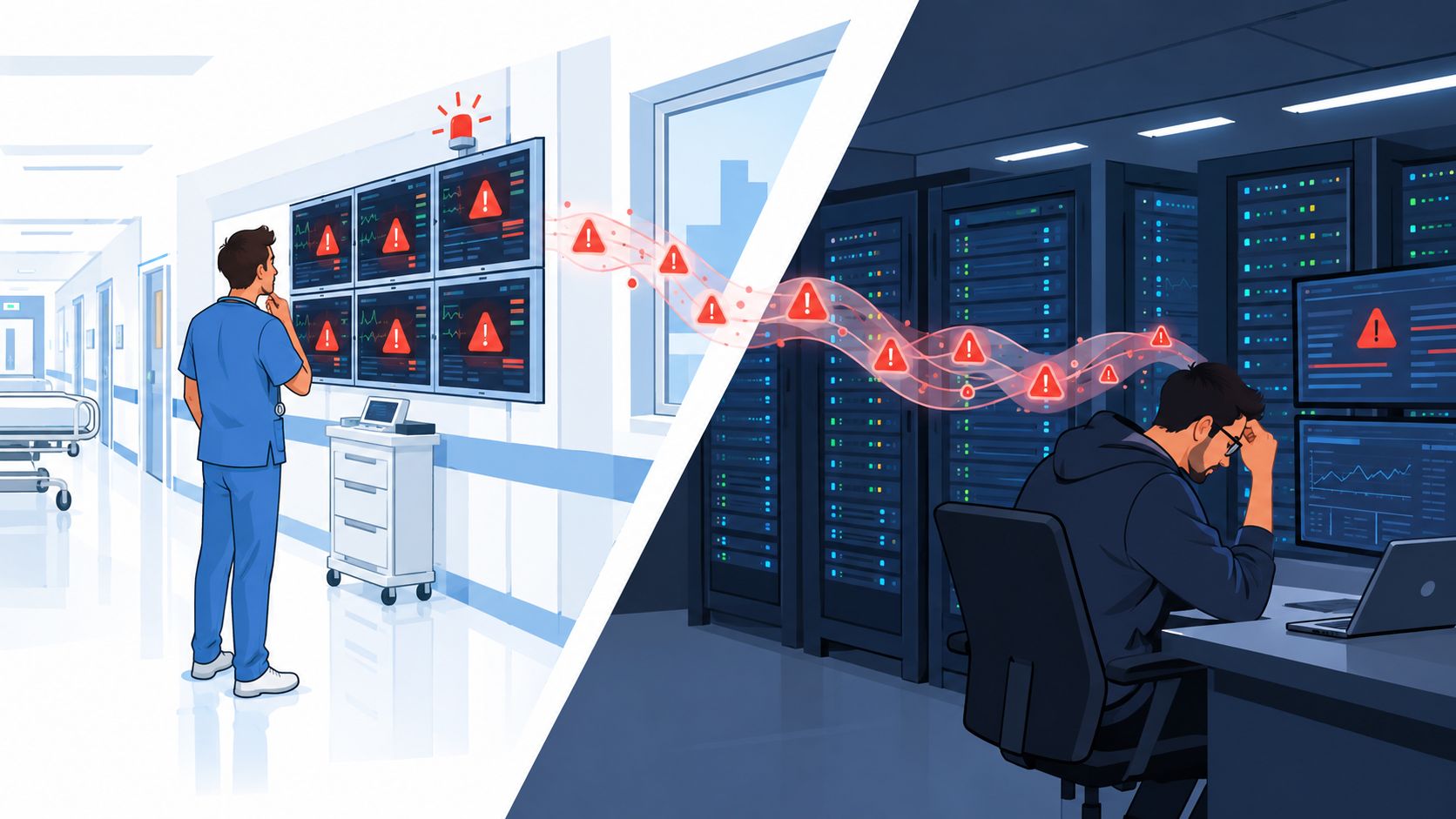
The clinical and infrastructure settings differ, but both depend on someone interpreting a warning correctly.
Transfer the mechanism, not the statistics
Those patient-safety figures aren't evidence of equivalent outcomes in website operations. The transferable lesson is narrower: installing detection equipment doesn't guarantee that the person receiving its output will recognize and act on the important signal.
For an uptime team, the warning might concern an API timeout, a DNS inconsistency, or a certificate validation failure. The responder still has to decide whether the observation is credible, whether it affects users, and what action is justified.
- Clinical setting: A clinician must distinguish an actionable patient condition from an uninformative alarm.
- Infrastructure setting: An engineer must distinguish a meaningful service failure from a probe observation that needs no intervention.
- Shared design responsibility: The organization must make that distinction practical during concurrent work.
The consequences and professional responsibilities aren't interchangeable. Neither are the clinical percentages and an infrastructure team's false-positive rate.
What travels is the human constraint: attention is limited, interpretation takes effort, and earlier experience influences how seriously someone treats the next warning. Uptime teams should therefore design notification workflows as part of incident response, rather than assume that detecting a failure completes the job.
The Four Drivers That Cause Fatigue
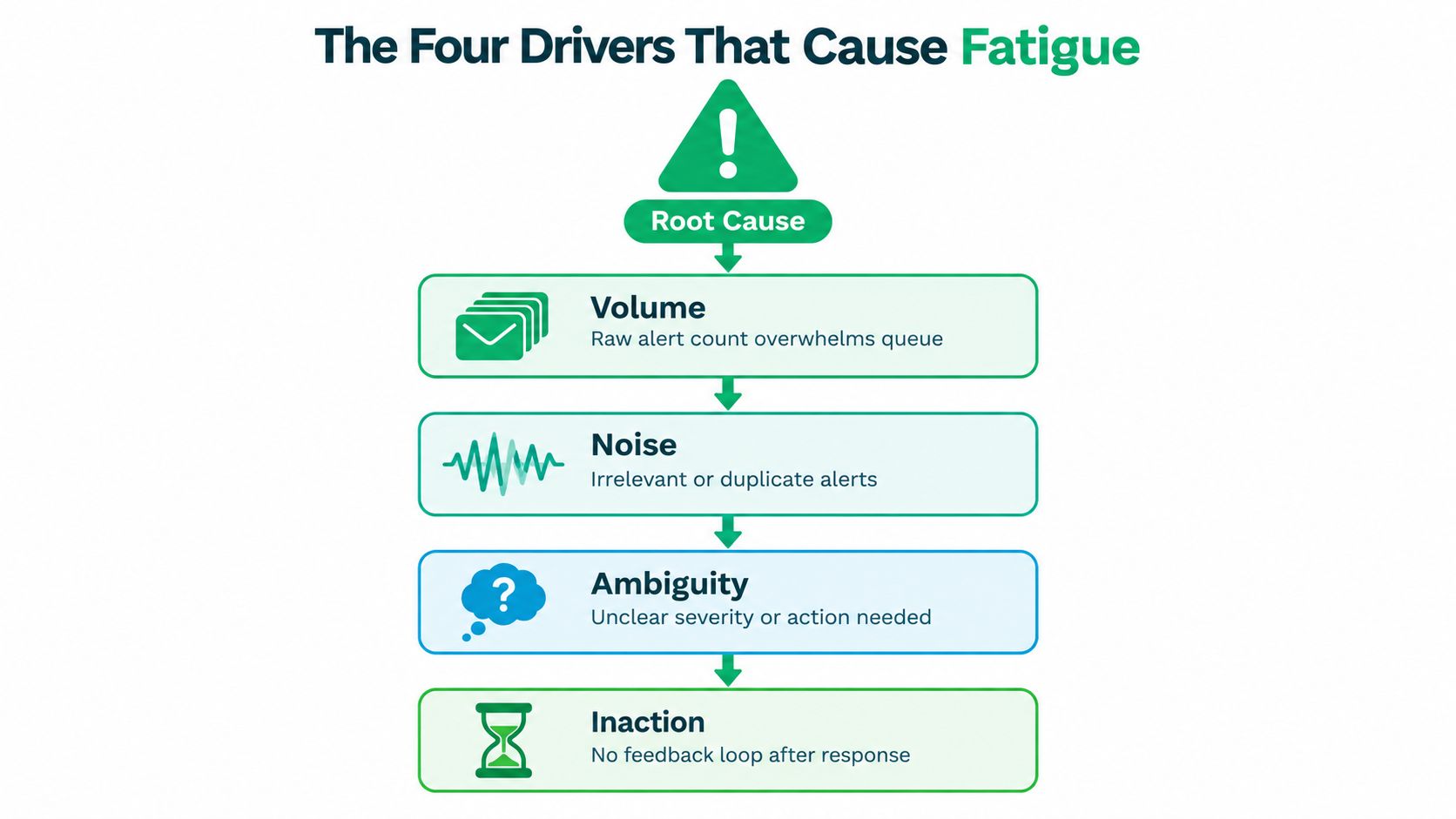
An alert queue can become difficult for different reasons. Treating every problem as excessive volume encourages teams to silence messages when they should instead repair context, ownership, or detection logic.
The visual below highlights common symptoms, including ambiguity and unresolved repetition. For operational diagnosis, separate the causes into volume, signal quality, concurrent cognitive load, and routing.
Workload and information value
Raw volume creates a review workload. Suppose an agency routes notifications from unrelated client sites into the same on-call inbox. Even meaningful alerts become difficult to process when they arrive faster than the assigned person can investigate them.
Poor signal-to-noise ratio creates a different problem. A latency threshold that repeatedly switches between warning and recovery generates messages without necessarily changing the response. Duplicate notifications can leave the engineer reviewing the same evidence again.
Clinical measurement research also treats alert burden as more than a count, including acceptance, dismissal, and repeated notifications, as described in this review of alert-fatigue measures. Infrastructure teams should similarly ask what information each additional message contributes.
Attention and ownership
The remaining drivers concern the person receiving the alert:
- Concurrent cognitive load: An engineer coordinating a rollback has little spare capacity to decode an ambiguous warning. Missing endpoint, region, or impact details make the interruption harder to handle.
- Poor routing: A certificate alert sent to a team without responsibility or access requires another handoff before anyone can investigate. Repeated ownership mismatches can make recipients treat the channel as someone else's problem.
The following video provides another format for considering alert fatigue alongside these operational questions.
A low-volume example makes the distinction clear: an occasional message that merely says a service is unhealthy can still demand a frustrating search across dashboards and teams. Reducing its frequency won't fix the missing explanation.
Use the About Monitoring reference as context when reviewing what your checks observe. Then compare each observed condition with the decision and ownership your notification communicates.
Why Counting Alerts Does Not Measure Fatigue
Alert counts tell you about incoming workload. They don't tell you whether responders are becoming less capable of handling important incidents.
In a clinical study, reminder acceptance probability fell by approximately 30% for each additional reminder received during an encounter, according to the longitudinal study of alert workload and repeated reminders. That's evidence of behavior changing with burden in that setting, not a percentage to apply to your on-call team.
Volume Metrics vs Quality Metrics for Alert Fatigue
| Metric Type | What It Shows | What It Misses | When It Misleads |
|---|---|---|---|
| Notification count | Incoming workload | Usefulness and response correctness | A busy but effective channel looks unhealthy |
| Acknowledgement latency | Time until someone acknowledges | Whether investigation begins | A quick click is mistaken for meaningful action |
| Actionable-alert rate | Share requiring an operational response | Important failures never detected | Strong precision hides gaps in coverage |
| Repeat-alert ratio | Repeated exposure to the same condition | Whether an update adds new evidence | Necessary escalation is counted as duplication |
| Time to diagnose | Effort needed to understand a condition | Correctness of the eventual decision | A rushed guess looks like improvement |
| Appropriate-response rate | Whether handling matches the condition | Context unless cases are reviewed | Different severities are pooled together |
Establish a response baseline
The strongest assessment asks whether appropriate responses decline sustainably relative to a baseline, while accounting for other influences on engagement. A systematic review of alert-fatigue definitions and measurement recommends this distinction rather than inferring fatigue from acceptance or override rates alone.
For an uptime team, appropriate handling could mean investigating a credible outage, escalating to the responsible service owner, or correctly dismissing a verified benign observation. Acknowledging everything isn't better than dismissing some alerts.
- Segment the evidence: Compare alerts within the same service, severity, and response team.
- Review decision outcomes: Record whether the alert changed an operator's action and whether that action was justified.
- Check alternative explanations: Delivery failures, incorrect routing, staffing changes, and healthy triage can affect engagement metrics.
- Include misses: Review incidents where the expected investigation never began.
A reduction in notifications is therefore an intervention result, not proof that fatigue improved. Judge the change by the team's ability to handle meaningful failures correctly.
Practical Controls That Reduce Fatigue
Start with a noisy alert rule and inspect what happens between detection and response. The useful question is what you can change so the next message requires less reconstruction and supports a clearer decision.
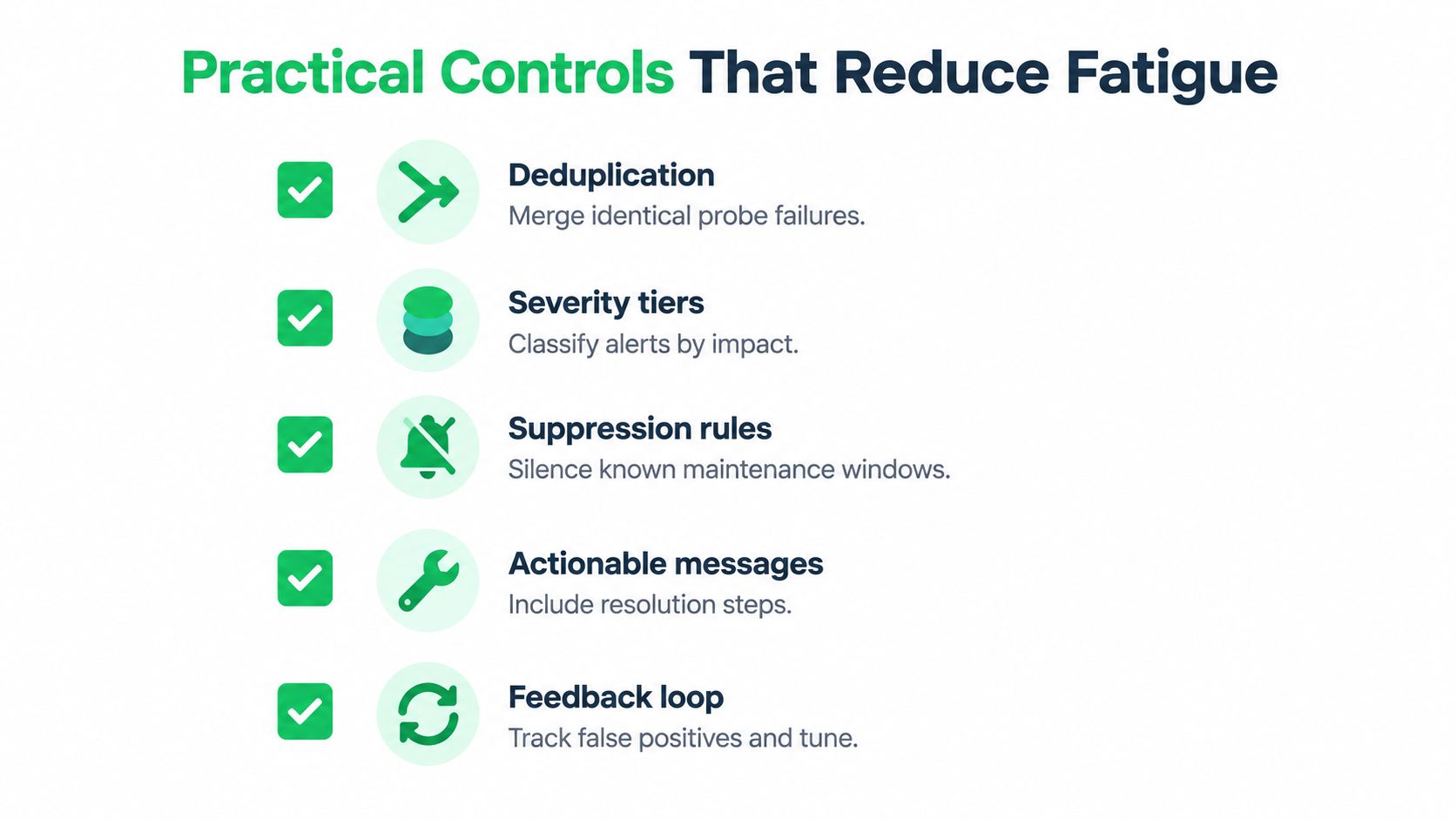
The controls below provide an audit vocabulary, not a promise that every monitoring product implements them.
Change notification behavior
- Deduplicate identical observations: Update an existing incident rather than send a fresh notification for every repeat of the same probe failure.
- Group related symptoms: Put associated availability, DNS, and connection evidence into an incident timeline so the responder can examine the relationship.
- Apply hysteresis where appropriate: Use different entry and recovery conditions to prevent repeated switching near a threshold. Consecutive-failure rules offer another way to confirm persistence, but test the detection delay they introduce.
- Separate severity tiers: Keep informational observations distinct from conditions requiring immediate investigation. Base the distinction on impact and the response expected.
- Scope maintenance suppression: Limit it to the affected checks and planned change window. Keep unrelated failure detection active.
- Route by service ownership: Send the message to a team with responsibility, access, and a documented escalation path.
For threshold review, the web server metrics alert guide from UpTime Web Hosting is a relevant companion resource. Treat thresholds as settings to validate against your service, not universal instructions.
Make the first view decision-ready
A notification should identify the affected service and endpoint, summarize available regional evidence, distinguish HTTP, DNS, and TLS symptoms, and name the responsible team. Include the next investigation step or relevant runbook.
A responder should be able to explain why they're opening the alert before they start searching other systems.
SiteAlive - are your website down? is one option for website and API availability monitoring with incident history and diagnostic utilities. Consult its monitoring workflow explanation when evaluating how checks fit your response process; apply the same audit to a routing service or homegrown script.
Finally, record responder feedback. An alert that repeatedly produces no justified action needs review, while an unclear message needs better context rather than automatic removal.
The Danger of Over-Suppression
Suppose a website remains reachable from most monitoring locations, but users in a particular geography can't connect. A grouping rule that labels all endpoint failures as the same already-handled problem could prevent the responder from noticing that the affected area has changed.
That's a hypothetical failure mode, not an argument against grouping. It illustrates why fewer notifications aren't automatically safer: the useful target is less redundant interruption without losing meaningful evidence.
Keep independent evidence visible
Website reliability can differ across geography, DNS resolver, ISP, protocol, or TLS path. The attention-capacity trade-off also appears in security operations, where high-recall detection and finite investigation capacity must coexist; research on AI-based alert screening discusses filtering, triage, correlation, and augmentation as distinct functions.
When designing aggregation, retain these dimensions:
- Geography and endpoint: Can the responder identify a newly affected region or service path?
- Dependency and failure type: Are connection errors distinguishable from DNS or TLS evidence?
- Status and certificate state: Does a changed failure condition remain visible?
- Duration and recurrence: Can the responder distinguish persistent impact from intermittent observations?
Grouping can keep related evidence together without treating every observation as interchangeable. A change in an independent dimension may justify updating the incident's severity or notifying the owner again.
Make automation inspectable
Prefer automation that ranks and enriches uncertain alerts over automation that discards them without notice. Keep raw events accessible, show the confidence behind a classification, and preserve the rationale for associating symptoms with an incident.
Safety boundary: Suppression should remove redundant interruptions, not the evidence needed to discover that the situation has changed.
Test proposed rules against regional and intermittent failure scenarios before relying on them. Ask whether the responder would still see a meaningful change, whether an uncertain case has an escalation path, and whether an investigator could later reconstruct what happened.
A quiet channel is reassuring only when you can explain what remains monitored and how meaningful failures would still reach a human.
A Short Operating Checklist for Alert Hygiene
Make alert hygiene part of service ownership rather than an occasional cleanup after a difficult on-call shift. Assign someone to review the notification rules alongside the service's runbooks and incident process.
The review should produce specific changes: corrected destinations, clearer messages, tested grouping rules, or documented reasons to retain a disputed alert. Avoid ending with a general instruction for engineers to pay closer attention.
Questions for the next review
- Severity and ownership: Does every interrupting alert identify the expected response and responsible team?
- Actionability and repetition: Which rules produce justified action, and which repeatedly expose responders to unchanged conditions?
- Routing health: Consider a weekly audit of team destinations, access requirements, and escalation paths.
- Grouping safety: Can responders still inspect independent failure dimensions and significant changes?
- Response baselines: Review team-level trends quarterly, or after major workflow changes, rather than interpret isolated acknowledgement figures.
- Incident evidence: Compare notification decisions with confirmed failures and missed investigations.
These review intervals are suggested operating habits, not universal research-backed thresholds. Adjust them to the rate at which your services, ownership, and alert rules change.
Review the decisions, not just the settings
Use an incident timeline as a conversation aid. Ask the responder what they knew when the message arrived, what remained unclear, and what they did next; the outages directory also provides context for thinking about observable availability failures.
Return to the engineer who muted the channel. The useful outcome isn't a promise never to mute anything again, but a redesign that makes the next important notification distinguishable and actionable.
Alert fatigue is a human-response failure, not an alert-count threshold. Evaluate it through the quality of operational decisions, repair the workflow that makes those decisions difficult, and check that quieter alerting hasn't created dangerous blind spots.
SiteAlive offers website and API availability monitoring, incident history, and network diagnostic tools to help you investigate what an alert means. Visit SiteAlive - are your website down? to review your website's availability and explore the evidence you can bring into a clearer, more actionable response workflow.